About Confluence
Chesapeake Bay is the largest estuary in the United States and the third largest in the world. Its watershed extends some 64,000 square miles into six states—Virginia, West Virginia, Maryland, Delaware, Pennsylvania, and New York—and the District of Columbia and is home to more than 18 million people. The Bay’s watershed is also home to one-third of the Atlantic migratory bird population, some 2,700 plant species, and more than 500 finfish and shellfish species. Chesapeake Bay and its watershed are quite simply a national and regional natural treasure. Yet it is threatened.
Since 2008, I have traversed nearly every corner of the Bay and its watershed, focusing on the notable confluences of rivers, streams, and creeks that comprise the watershed. These photographs capture the “confluence” and “interface” between the natural and cultural landscapes that define the Bay and our place in it.
Confluence: Rivers and Streams in the Chesapeake Bay Watershed is expected as a 184-page book from George F. Thompson Publishing in October 2026. It features ten insightful essays and ten additional commentaries by some of the Bay’s most notable scientists, curators, scholars, writers, activists, riverkeepers, and political and spiritual leaders, including a foreword by William C. Baker, President of the Chesapeake Bay Foundation from 1981 to 2021, an introduction by Seth Feman, Director and CEO of the Frist Art Museum in Nashville and former Curator of Photography and Deputy Director of the Chrysler Museum of Art in Norfolk, and Dr. Ralph Northam, Governor of Virginia from 2018 to 2022.
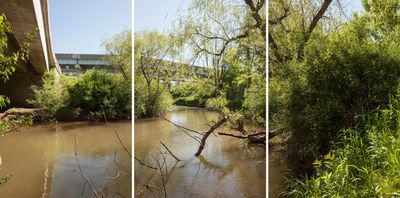
Confluence of Brush Creek and Little Brush Creek, Fulton County, Pennsylvania.